
They Asked Us To Build Software.
We Ended Up Automating How The Business Operated.
Build an AI-powered reporting platform that could help psychologists generate assessment reports faster.




5
Core modules
5
Integrations
1
Connected platform
Project Snapshot
- Industry
- Healthcare & Psychology
- Platform
- HIPAA-Conscious Web Application
- Focus
- Business Process Automation
- Integrations
- Twilio · Deepgram · Calendly · AWS · OpenAI
- Core Modules
- • Dynamic Assessment Engine• AI Report Wizard• Patient Management• Voice Agent• Admin Portal
The brief
The original request sounded simple.
Build an AI-powered reporting platform that could help psychologists generate assessment reports faster.
Upload patient information. Generate a report. Save clinicians time.
But once we started mapping how assessments actually worked, we discovered something unexpected.
The report wasn't the problem.
The Real Problem Was Hidden Upstream
Before a clinician can generate a report, they need information from multiple sources.
Everything needed to be gathered, reviewed, and organized before a report could even begin.
Patient details
Assessment scores
Behavioral observations
Interview notes
Referral information
What We Discovered
Most of the effort wasn't spent writing reports.
It was spent preparing the information needed to write them.
Even the best AI report writer wouldn't solve that bottleneck.
So we stopped thinking about reports and started thinking about workflows.
Engineering Note
This eventually led us to build a Dynamic Battery Engine, configurable metadata fields, reusable report templates, and clinician-driven workflows instead of a single-purpose report generator.
The bottleneck wasn't report generation. It was everything that had to happen first.
Why We Abandoned The Original Plan
The obvious solution was to build assessment-specific logic for batteries like WISC-V and others.
The more we researched, the less practical that approach became.
Every clinic uses different assessments. Every assessment has different structures. Every assessment requires different inputs.
Supporting each battery individually would eventually create hundreds of unique workflows that all needed maintaining.
Instead, we built a dynamic assessment architecture.
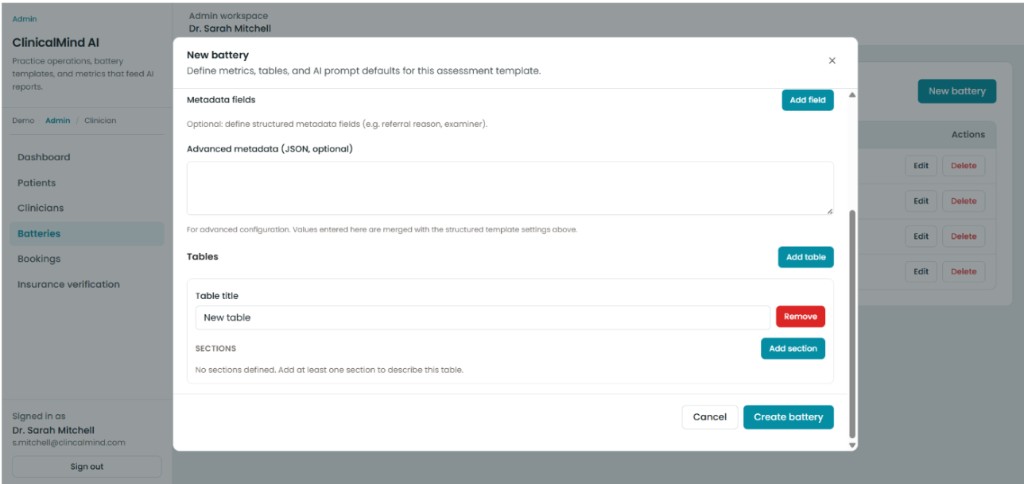
Administrators can configure batteries, prompts, input structures, validation rules, and report formats without requiring development work.
What started as an AI feature became a flexible assessment platform.
Engineering Note
The hardest part wasn't generating reports. It was designing a system that could support future assessments without requiring developers every time a new battery was introduced.
AI Without The Risk
AI replaces clinicians
AI assists clinicians
Healthcare requires a different approach to AI.
We didn't want AI diagnosing patients. We didn't want AI interpreting results. We didn't want AI making clinical decisions.
Instead, clinicians provide:
- Scores
- Percentiles
- Descriptors
- Clinical observations
- Assessment notes
The AI simply transforms structured information into professionally written report drafts.
The clinician remains the expert. The AI handles the writing.
Engineering Note
We created battery-specific prompt templates instead of relying on one universal prompt, while keeping clinicians responsible for the final review and approval.
Then We Found Another Time Drain
Call flow
Twilio voice workflow handling real-time appointment booking.
Engineering Note
During deployment we discovered that upgrading to a paid Twilio account wasn't enough for international calling. Voice Geographic Permissions also needed to be enabled for the countries being tested, otherwise outbound calls failed even though the voice workflow itself was fully operational.
As we continued mapping the workflow, another problem became obvious.
Many clinician interactions followed the same pattern every day.
A patient calls. They want an appointment. Staff checks availability. The patient provides details. Appointment gets booked. Repeat.
So we expanded the platform.
We built an AI voice assistant that can:
- Answer incoming calls
- Handle appointment requests
- Check availability
- Schedule appointments
- Send confirmations
- Notify clinic staff
Patients get a natural conversation. The clinic gets fewer interruptions.
Built For Healthcare From Day One
Because the platform handles protected health information, HIPAA compliance wasn't something that could be added later. It had to be part of the architecture from the beginning.
That influenced almost every technical decision we made.
Security, compliance, and usability were designed together rather than treated as separate concerns.
Role-based access control
Secure patient data storage
Audit logging
Structured data collection
Controlled access to clinical records
HIPAA-conscious cloud architecture
Engineering Note
We intentionally moved away from heavy PDF parsing in favor of structured clinician inputs. It simplified future assessment support while reducing the amount of unstructured patient data flowing through the platform.
What We Ended Up Building
By the end of the project, ClinicalMind AI had evolved far beyond the original scope.
The platform now includes:
Platform architecture
Dynamic Battery Engine
AI-Assisted Report Wizard
Patient Lifecycle Management
Clinician Portal
Admin Portal
Twilio Voice Appointment Workflow
Insurance Verification Research & Integration Planning
HIPAA-Conscious Infrastructure
Rather than solving one isolated problem, the platform connected multiple business processes into a single operational workflow.
Engineering Note
We also evaluated providers such as pVerify and other eligibility APIs to understand how automated insurance verification could become part of the patient's journey without introducing additional manual work.
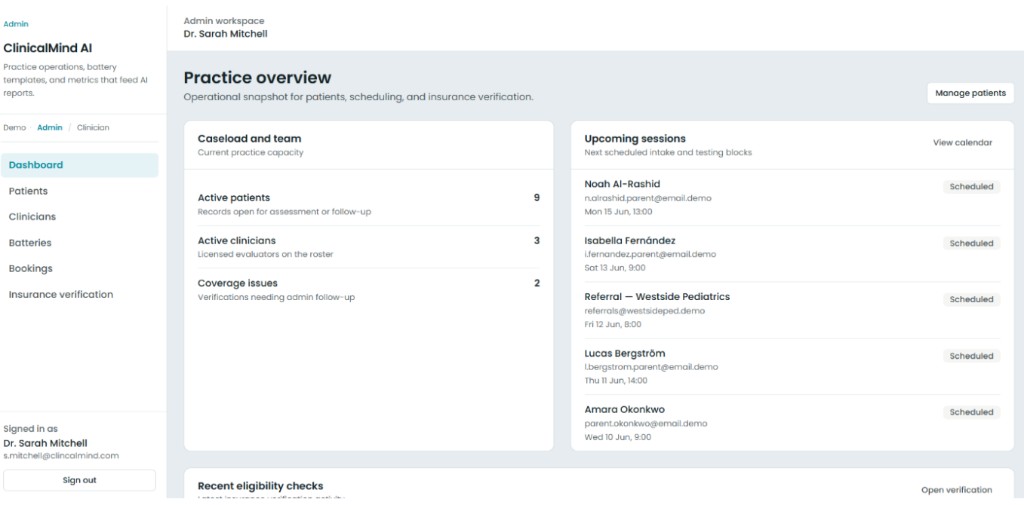
Administrator dashboard connecting patients, clinicians, assessments, and reports.
The Outcome
Clinicians spend less time on administration.
Assessment information stays organized.
Reports are generated faster.
Appointments can be booked automatically.
Patient information flows through one connected system.
Most importantly, clinicians can spend more time focused on patients instead of paperwork.
What started as an AI reporting project ultimately became a connected operational platform that automated how the practice handled assessments, appointments, reporting, and patient workflows.
Explore The Demo
Experience the platform from the perspective of a clinician and see how assessments, patients, reports, appointments, and administration work together inside a single connected workflow.